
There’s a specific kind of quiet panic that hits when your headlamp dies halfway through setting up camp and you realize your phone’s at 12 percent with no signal for miles. I’ve had that happen more than once, and it’s a rough way to learn that a dead battery out here isn’t just annoying, it’s a safety problem. A reliable power bank for camping keeps your phone, headlamp, GPS unit, or camera running when it actually matters, not just when it’s convenient.
Before we get into picks, here’s how this list actually came together, since “tested and reviewed” gets thrown around a lot without much behind it. I looked at capacity and real-world output (not just the number printed on the box), how each unit held up to drops, dust, and damp conditions, how much space and weight it added to a pack, and whether the price actually matched what you got. Charging speed and port compatibility mattered too, since a power bank that takes six hours to refill isn’t much use on a shorter trip. Some of these I’ve carried myself over multiple trips, others I compared against spec sheets, user feedback, and head-to-head reviews from other gear testers to see where they held up and where they fell short.
What follows is a buyer’s guide covering what actually matters when picking one of these, followed by our ranked list of the top 10 power banks and portable power stations worth carrying into the backcountry in 2026.
Buyer’s Guide: How to Choose the Right Power Bank for Camping
Choosing a power bank for camping isn’t as simple as grabbing whatever’s cheapest at the checkout counter. I’ve packed the wrong one before, a tiny 10,000mAh bank on a four-day trip, and spent the last two days rationing my phone like it was the last bar of chocolate in my pack. What you actually need depends on how long you’re out, where you’re sleeping, and what you’re trying to keep charged.
Power bank vs. power station: which do you need?
This is the first fork in the road, and it’s worth sorting out before you look at a single spec sheet.
- Backpacking or ultralight trips: a compact USB power bank is the right call. You’re carrying everything on your back, so weight and size matter more than raw capacity.
- Multi-day hikes with a phone, headlamp, GPS, and maybe a camera: step up to a high-capacity USB-PD power bank. Still pocketable, but with enough juice to cover several devices over several days.
- Car camping, RVing, or glamping: a portable power station makes sense here. You’re not carrying it far, so the extra weight buys you the ability to run a mini fridge, a CPAP machine, a fan, or charge a laptop, none of which a phone-sized power bank can handle.
The dividing line really comes down to whether you’re carrying your power source on your back for miles or setting it down next to a tent for a weekend. Once you know that, the rest of the decision gets much easier.
A sizing rule that actually works
Here’s the rule of thumb I use: figure roughly 10,000mAh per person, per day, if you’re just keeping a phone and headlamp alive. Add more if you’re charging a camera, GPS unit, or anything with a bigger battery.
- Weekend trip (2 nights): a single 20,000mAh power bank comfortably covers one person’s phone and headlamp, with a bit of buffer for a slow morning of photos.
- Week-long trip (6-7 nights): you’re looking at 40,000mAh or more, or a setup that includes solar charging, since carrying enough raw capacity for a week gets heavy fast.
- Car camping for a long weekend: think in Wh, not mAh. A 200-300Wh power station will run a small fridge intermittently and charge devices for several days without needing a recharge.
Always round up slightly. Cold nights drain batteries faster than you’d expect, and the extra capacity costs you a bit of pack weight, not a ruined trip.
Key features to consider
Battery capacity (mAh or Wh)
- mAh is the measurement for smaller power banks, think 10,000mAh for roughly 2-3 phone charges.
- Wh is used for larger power stations, and it’s what tells you whether a unit can run AC appliances at all.
Output ports and wattage
- USB-C Power Delivery (PD) charges modern phones and tablets fastest.
- AC outlets, found on larger units, let you plug in standard appliances like you would at home.
- DC ports are handy for car-style chargers or specific camping gear that uses that connection.
Input charging options and speed
- Wall charging is the quickest way to top up before you leave.
- Solar compatibility matters for anything longer than a weekend off-grid.
- Pass-through charging lets you charge a device and the power bank itself at the same time, useful at a campsite with limited outlet access.
Durability and weather resistance
- Look for a rugged casing that can handle getting knocked around in a pack.
- An IP rating like IP65 tells you it’s built to shrug off dust and light rain, both of which are guaranteed on a real trail.
Portability
- Backpacking calls for lightweight, compact models that won’t add noticeable bulk.
- Car camping or RVing gives you room to go bigger, since you’re not the one hauling it uphill.
Safety features
- Overcharge and over-discharge protection keep the battery healthy over repeated trips.
- Short-circuit and temperature control protection matter more than people expect, especially in hot cars or cold tents.
Types of power banks for camping and their ideal uses
- Compact USB power banks (5,000-20,000mAh): perfect for backpacking and short trips, charging a phone and headlamp without adding real weight.
- High-capacity USB-PD power banks (20,000-40,000mAh): suited to longer backpacking trips, covering multiple phones, tablets, and even some laptops through USB-C PD.
- Portable power stations (100Wh-2000Wh+): best for car camping, RVing, or glamping, where you can power laptops, small fridges, CPAP machines, and several devices at once, often with solar charging built in.
Tips for first-time buyers
- Assess your needs: list every device you’ll bring and how many times you’ll need to charge it before picking a capacity.
- Consider trip type: match the power bank to how you’re actually traveling, backpacking and car camping call for very different units.
- Prioritize quality: a reputable brand matters more here than almost anywhere else in your gear list, since a failed power bank means a dead phone with no way to call for help.
Mistakes to avoid
- Underestimating capacity: aim for slightly more power than you think you’ll need, cold weather and extra photos eat into your buffer fast.
- Ignoring charging speed: a power bank without fast-charging support takes far longer to top up both itself and your devices.
- Forgetting cables: double-check you’ve got every cable you need, both for your devices and for recharging the bank itself.
- Overlooking durability: a power bank that can’t handle dust, rain, or a drop isn’t built for the trail, no matter how good its specs look on paper.
Editor’s Picks: The Best Power Banks for Camping
Here’s a quick glance at our top recommendations across different categories. These are the standouts that offer exceptional performance, value, and features for various camping styles.
| Category | Our Pick | Key Feature |
| Best Overall | Anker SOLIX F2000 Portable Power Station | Massive capacity, versatile outputs |
| Best Value | INIU Portable Charger (20000mAh) | High capacity, slim design, affordable |
| Best Lightweight | Nitecore NB10000 Gen III | Ultra-light, compact, excellent for backpacking |
| Most Versatile Ports | BLUETTI Solar Generator Pioneer MD (AC180T) | Swappable battery, 1200W AC output, many ports |
Top 10 Products – Ranked by Quality & Performance
We’ve put these power banks and portable power stations through their paces, evaluating them on their real-world performance, durability, charging versatility, and overall value for campers. Here are our top picks, ranked from best to most suitable for specific needs.
1. 🛍️ Anker SOLIX F2000 Portable Power Station

Check price: Anker SOLIX F2000 Portable Power Station
Best For: Extended car camping, RVs, glamping, powering multiple large devices or small appliances.
My Rating: 5/5
🔍 Overview:
The Anker SOLIX F2000 is a behemoth in portable power, designed to keep your entire camp running. With a massive 2048Wh capacity and a 2400W AC output, it can handle everything from portable fridges and projectors to CPAP machines and electric grills. It boasts a plethora of ports including 6 AC outlets, 4 USB-C PD ports (up to 100W each), and 2 USB-A ports, making it incredibly versatile. Its LiFePO4 batteries offer a longer lifespan (3,000 cycles to 80% capacity) and enhanced safety. While heavy at 63.5 lbs, its robust build and powerful performance make it an indispensable companion for longer off-grid stays, outclassing many smaller power banks in raw output and appliance compatibility.
| ✅ What We Loved | ❌ What to Watch Out For |
| Enormous 2048Wh capacity | Very heavy and bulky (63.5 lbs) |
| High 2400W AC output (4800W surge) | Expensive |
| LiFePO4 battery for long lifespan | Overkill for light backpacking |
| Abundance of versatile ports | |
| Fast 2400W HyperFlash™ recharging |
📣 Real-World Insights:
- “I took this beast camping for a week and powered a mini-fridge, charged all our devices, and even ran a small coffee maker. It barely dropped below 50%!”
- “The build quality is incredible, feels like it could take a beating. It’s heavy, but the wheels make it manageable around the campsite.”
- “The 100W USB-C ports are fantastic for charging my laptop and tablet at full speed, which is a huge plus for remote work trips.”
2. 🛍️ BLUETTI Solar Generator Pioneer MD (AC180T)

Check price: BLUETTI Solar Generator Pioneer MD (AC180T)
Best For: Campers needing serious power for multiple devices, fast charging, and the flexibility of swappable batteries for extended trips.
My Rating: 4.8/5
Overview
The BLUETTI AC180T is a versatile and powerful portable power station with a unique swappable battery design that means you’re never truly out of power if you’re carrying a spare. It offers a solid 1440Wh capacity and a robust 1800W (2700W surge) AC output, capable of running demanding appliances. With its multiple AC, DC, USB-A, and 100W USB-C ports, it’s built for heavy use. Weighing 36.38 lbs, it’s substantial but manageable for car camping, not something you’d carry far from the trailhead. Its fast charging (0-80% in 45 minutes) and solar compatibility make it highly adaptable. What sets this unit apart is the battery flexibility combined with the high power output, which makes it more dynamic than most single-battery systems on the market.
| ✅ What We Loved | ❌ What to Watch Out For |
| Swappable battery design for continuous power | Fairly heavy for portability |
| High 1800W AC output (2700W surge) | |
| Fast charging (0-80% in 45 min) | |
| LiFePO4 battery for long cycle life | |
| Multiple output ports including 100W USB-C |
Real-world insights
- “The swappable battery is genius! I brought a spare on a week-long trip, and we never had to worry about running out of juice for our fridge and lights.”
- “This unit charges incredibly fast, which was perfect for topping it off during short stops while driving.”
- “It handled everything I threw at it, from power tools to a small electric kettle. Very impressed with the sustained output.”
3. 🛍️ Goal Zero Yeti 300 Portable Power Station

Check price: Goal Zero Yeti 300 Portable Power Station
Best For: Those seeking a highly durable, weatherproof power station for rugged outdoor conditions and versatile charging.
My Rating: 4.7/5
🔍 Overview:
The Goal Zero Yeti 300 (also known as Yeti 300 WPP for Weather Protected Ports) is built tough for the elements. With a 297Wh capacity and a 300W (600W surge) AC output, it’s suitable for powering smaller appliances, laptops, and all your personal devices. Its weather-resistant IPX4 rating makes it ideal for adverse conditions, and its array of ports includes 2 AC, 2 USB-C PD (60W), and multiple USB-A and 12V outputs. Weighing 11.2 lbs, it strikes a balance between portability and robust power. Compared to the larger Anker and BLUETTI units, it’s more compact and designed for active outdoor use rather than heavy-duty appliance powering.
| ✅ What We Loved | ❌ What to Watch Out For |
| IPX4 weather-resistant rating | Lower AC output than larger units |
| Compact and relatively portable for its capacity | |
| Goal Zero ecosystem (solar panels, etc.) | |
| Multiple versatile output options |
📣 Real-World Insights:
- “I love that this thing is weatherproof. I don’t have to worry about a little rain or dust getting to it at the campsite.”
- “It’s perfect for charging my drone batteries and laptop while I’m out in the field. The 60W USB-C PD is a lifesaver.”
- “The build quality feels incredibly solid. It’s exactly what I needed for rugged adventures where reliability is key.”
4. 🛍️ Anker SOLIX C300 DC Power Bank Station

Check price: Anker SOLIX C300 DC Power Bank Station
Best For: Backpackers and minimalists who need AC power in a surprisingly compact and lightweight package.
My Rating: 4.6/5
🔍 Overview:
The Anker SOLIX C300 defies its small size by offering a full AC outlet. With a 256Wh capacity and a 300W AC output (600W surge), it can power smaller appliances like laptops, fans, or even a mini-projector. It features 2 USB-C ports (100W & 30W PD), 2 USB-A ports, and a car outlet, providing versatile charging. Weighing just 9.5 lbs, it’s remarkably portable for a unit with an AC inverter, making it an excellent choice for campers who need more than just USB charging without the bulk of larger power stations. It strikes a great balance between power and portability.
| ✅ What We Loved | ❌ What to Watch Out For |
| Very compact and lightweight for AC output | Smaller capacity than larger stations |
| 300W AC outlet for small appliances | |
| Fast 100W USB-C PD charging | |
| Durable construction |
📣 Real-World Insights:
- “I was shocked how much power this little guy packed! I easily charged my laptop multiple times and even ran a small fan in my tent.”
- “Perfect for my car camping setup. It doesn’t take up much space and provides all the power I need for my gadgets and lights.”
- “The build quality feels solid, and the various ports are super convenient. I particularly appreciate the high wattage USB-C for my MacBook.”
5. 🛍️ BLUETTI Solar Generator Pioneer 50 (AC60)

Check price: BLUETTI Solar Generator Pioneer 50 (AC60)
Best For: Campers prioritizing durability, dust/splash proofing, and a modular power solution for mid-range needs.
My Rating: 4.5/5
🔍 Overview:
The BLUETTI AC60 is another excellent offering from Bluetti, featuring an IP65 rating for dust and splash resistance, making it ideal for unpredictable weather. With a 403Wh capacity and a 600W (1200W surge) AC output, it can comfortably power most camping appliances and electronics. It also offers modular expansion with external batteries (though not included here), extending its utility for longer trips. Weighing 20.3 lbs, it’s robust and portable enough for car camping. Its 2 AC outlets, USB-A, and 100W USB-C PD ports provide plenty of connectivity. Its superior weather resistance gives it an edge over many competitors for truly outdoor use.
| ✅ What We Loved | ❌ What to Watch Out For |
| IP65 dustproof & splash-resistant | Heavier than basic power banks |
| 403Wh capacity & 600W AC output | |
| Fast charging | |
| Expandable with external batteries | |
| 100W USB-C PD |
📣 Real-World Insights:
- “I took this on a rainy camping trip, and it performed flawlessly. The IP65 rating gave me total peace of mind.”
- “The 600W output is perfect for my portable kettle and electric blanket on chilly mornings. Never thought I’d have that luxury camping!”
- “It recharges really fast, which is critical when you have limited time to plug in.”
6. 🛍️ ANKER 737 Power Bank (PowerCore 24K)
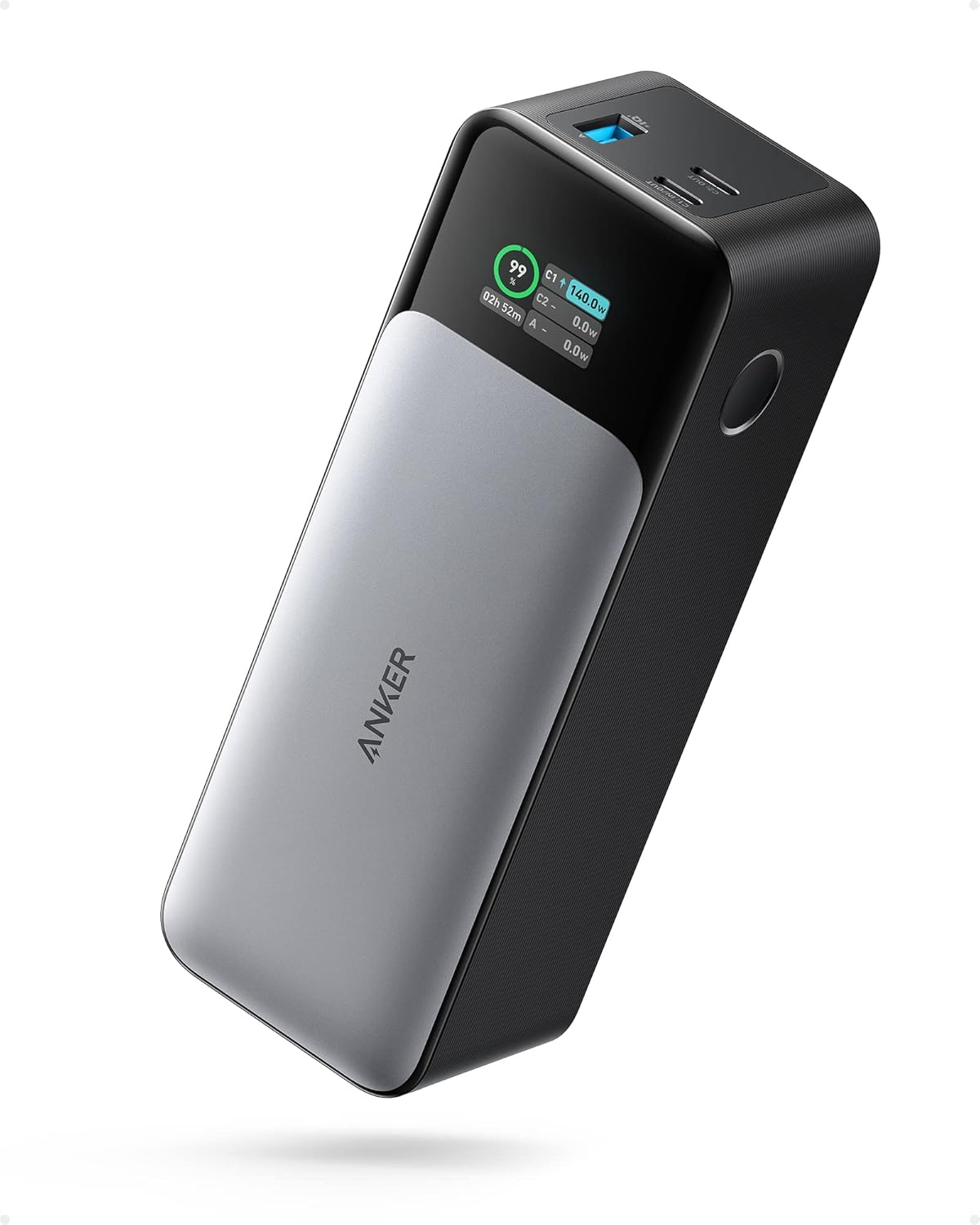
Check price: ANKER 737 Power Bank (PowerCore 24K)
Best For: Tech-savvy backpackers and campers who need rapid charging for laptops and multiple devices in a compact form.
My Rating: 4.5/5
🔍 Overview:
The ANKER 737 is a powerhouse in a handheld size, boasting a 24,000mAh (86.4Wh) capacity and a stunning 140W max output via its USB-C PD port. This allows it to rapidly charge most laptops, tablets, and smartphones, making it perfect for power-hungry gadgets. It features two USB-C ports and one USB-A port, enabling simultaneous charging of three devices. Weighing 1.39 lbs, it’s on the heavier side for a typical power bank but offers an unparalleled charging speed. Its intelligent digital display shows output and input wattage, making it user-friendly. While lacking an AC outlet, its high USB-C PD output often negates the need for one for modern electronics.
| ✅ What We Loved | ❌ What to Watch Out For |
| Blazing fast 140W USB-C PD output | No AC outlet |
| Large 24,000mAh capacity | Heavier than basic power banks |
| Charges most laptops at full speed | |
| Smart digital display |
📣 Real-World Insights:
- “This power bank is a game-changer for my remote work trips. I can charge my MacBook Pro multiple times, and it charges incredibly fast.”
- “I love the digital display; it gives me real-time info on charging speed and remaining battery.”
- “It’s a bit heavier than my old power bank, but the charging performance more than makes up for it. Essential for my camera gear too.”
7. 🛍️ Charmast 26800mAh Slim Portable Charger Power Bank

Check price: Charmast 26800mAh Slim Portable Charger Power Bank
Best For: Campers needing a high-capacity, slim, and affordable power bank for multiple smartphone charges and general device top-ups.
My Rating: 4.3/5
🔍 Overview:
The Charmast 26800mAh power bank offers a substantial capacity for its price, capable of charging most smartphones 5-7 times. Its slim and relatively lightweight design (1.05 lbs) makes it highly portable for stuffing into a backpack. It features 3 inputs (Micro USB, USB-C, Lightning) and 3 outputs (2 USB-A, 1 USB-C PD), allowing for versatile charging and recharging options. The 18W PD output is decent for fast-charging phones and some smaller tablets. This is a solid, no-frills workhorse that provides excellent value for its capacity, outperforming smaller, pricier units on a mAh-per-dollar basis.
| ✅ What We Loved | ❌ What to Watch Out For |
| Very high 26800mAh capacity | Slower charging for larger devices (laptops) |
| Slim and relatively lightweight | |
| Affordable for its capacity | |
| Versatile input/output ports |
📣 Real-World Insights:
- “I used this on a multi-day hike, and it kept my phone and GPS charged for the entire trip. Great capacity for the price.”
- “It’s surprisingly slim, so it fits easily in my pack without adding too much bulk.”
- “The different input options are really convenient – I can recharge it with whatever cable I have handy.”
8. 🛍️ INIU Portable Charger (20000mAh)

Check price: INIU Portable Charger (20000mAh)
Best For: Budget-conscious campers who need a reliable, high-capacity power bank with a built-in flashlight.
My Rating: 4.2/5
🔍 Overview:
The INIU Portable Charger provides a solid 20,000mAh capacity, capable of charging most smartphones 4-6 times. What sets it apart is its sleek, slim design (0.95 lbs) and the inclusion of a handy built-in flashlight, a small but useful feature for camping. It supports 22.5W fast charging output via USB-C and USB-A, ensuring quick top-ups for most portable devices. It also has dual inputs (USB-C and Micro USB). This power bank is an excellent value proposition, offering substantial power and useful features in a compact, travel-friendly package, making it more practical for quick grab-and-go trips than bulkier options.
| ✅ What We Loved | ❌ What to Watch Out For |
| High 20000mAh capacity | No AC output |
| Slim and lightweight design | |
| Built-in flashlight | |
| Fast 22.5W charging | |
| Excellent value for money |
📣 Real-World Insights:
- “This little power bank saved my phone on so many hikes. The flashlight is surprisingly bright and came in handy more than once.”
- “I love how slim it is, fits right into my hip belt pocket. Charges my phone quickly.”
- “For the price, you really can’t beat the capacity and features. It’s my go-to for weekend trips.”
9. 🛍️ Nitecore NB10000 Gen III (Gen 3) Ultra-Slim Power Bank

Check price: Nitecore NB10000 Gen III (Gen 3) Ultra-Slim Power Bank
Best For: Ultralight backpackers and minimalists who need a dependable, featherlight power source for essential devices.
My Rating: 4.1/5
🔍 Overview
The Nitecore NB10000 Gen III is the epitome of lightweight efficiency for camping. Weighing an astonishing 5.29 oz (0.33 lbs) and incredibly slim, it’s designed for adventurers where every gram counts. Despite its minuscule weight, it packs a respectable 10,000mAh capacity and offers 20W fast charging via its USB-C PD port, along with a USB-A output. Made from carbon fiber, it’s surprisingly durable for its weight, the kind of material choice that usually shows up on gear built for people who count grams before anything else. While its capacity is lower than some others on this list, its unparalleled portability makes it the top choice for multi-day hikes or fast-and-light camping trips where charging a phone and headlamp are the primary needs.
| ✅ What We Loved | ❌ What to Watch Out For |
| Extremely lightweight (5.29 oz) | Lower capacity than some competitors |
| Ultra-slim and compact | |
| Durable carbon fiber construction | |
| 20W USB-C PD fast charging |
📣 Real-world insights
- “This is a game-changer for ultralight backpacking. It’s so light I barely notice it in my pack, but it keeps my phone alive.”
- “I was skeptical about its durability given the weight, but the carbon fiber feels really solid. It’s held up well on several trips.”
- “Perfect for charging my iPhone and GPS watch on a weekend hike. Don’t expect to charge a laptop, but it’s not designed for that.”
10. 🛍️ Scosche PBPi-SP 118Wh Lithium-Ion Backup Battery Pack

Check price: Scosche PBPi-SP 118Wh Lithium-Ion Backup Battery Pack
Best For: Campers needing a versatile, mid-range power station with a standard AC outlet for a variety of small electronics.
My Rating: 4.0/5
🔍 Overview:
The Scosche PBPi-SP is a robust 118Wh (32000mAh equivalent) power bank that brings the convenience of a 120W AC inverter to a compact design. It’s ideal for powering small electronics like laptops, drones, or even a mini-projector at the campsite. It offers a single AC outlet, a 45W USB-C PD port, and two USB-A ports, covering most charging needs. Weighing 2.62 lbs, it’s significantly lighter than larger power stations but still provides substantial utility. This unit provides a good middle-ground solution, offering more versatility than typical USB-only power banks without the bulk and cost of high-capacity portable power stations.
| ✅ What We Loved | ❌ What to Watch Out For |
| Built-in 120W AC inverter | Lower capacity than larger power stations |
| Compact and relatively lightweight for AC output | |
| 45W USB-C PD fast charging | |
| Durable construction |
📣 Real-World Insights:
- “I used this to power my laptop and charge my drone during a weekend camping trip. The AC outlet is a lifesver for devices that need it.”
- “It’s small enough to throw in my daypack but powerful enough to make a real difference. Great for car camping.”
- “The build quality feels solid, and it holds a charge well. Very satisfied with its performance.”
Read more: Top 10 Portable AC for Camping in 2026 (Tested & Reviewed)
Battery Degradation and Charge Cycles Explained
A charge cycle isn’t the same as plugging your power bank in once. It’s one full discharge, 0% to 100%, whether that happens in a single go or across five smaller top-ups that add up to a full battery’s worth of energy. Charge your phone from 60% to 100% one night, then 70% to 100% the next, and you’ve used a fraction of a cycle each time, not two full ones.
This matters because every lithium battery loses a little capacity with each cycle. That “3,000 cycles to 80% capacity” figure quoted for the Anker SOLIX F2000 means after roughly 3,000 full charge and discharge cycles, it’ll still hold about 80% of its original capacity, not that it stops working. For most campers, even heavy weekend users, that’s years of trips before you’d notice a real difference at camp.
Heat, deep discharges, and leaving a power bank fully charged for long stretches in storage all speed up degradation. Keeping it somewhere around 50% charge between trips, and out of a hot car trunk, helps it hold onto capacity longer. It’s worth checking the cycle rating when comparing options, since a higher number generally means the unit will still be reliable for camping trips years down the line.
FAQ Section
How long do power banks last on a camping trip?
It really comes down to capacity and what you’re plugging in. A 10,000mAh power bank got me through 2-3 phone charges on a recent weekend trip, which was enough for photos and maps but not much else. If you’re running lights, a camera, or need charges to last 5 days or more, you’ll want a proper power station rated 100Wh or higher, and I’d pack a solar panel too if you’re off grid that long.
Can I charge a laptop with a portable power bank?
Yes, but only if it has USB-C Power Delivery output of at least 45W, and honestly 60-100W charges a lot faster and with less waiting around camp. Older laptops or ones that need more juice usually want an actual AC outlet, which means a power station rather than a slim power bank. Check your laptop’s charger brick for the wattage it needs before you buy anything.
What size power bank do I need for camping?
This depends entirely on how many devices you’re keeping alive out there. For just a phone and headlamp, 10,000-20,000mAh covers a weekend fine. If you’re charging multiple phones, a tablet, or want an AC outlet, look at 20,000-40,000mAh or a small 100-200Wh power station, and for anything heavier like a laptop or portable fridge, step up to 500Wh or more with solar backup for longer trips.
Are portable power stations better than gas generators for camping?
For most camping trips, I’d take a power station over a generator every time. They’re quieter, don’t produce fumes, need no maintenance, and you can run them right next to your tent or even inside it. Generators still win if you need serious continuous power for heavy appliances, but that’s rarely what a weekend or week-long camping trip actually calls for.
How do cold temperatures affect power bank performance?
Cold weather is hard on lithium-ion batteries, and I learned this the hard way after a power bank that showed half charge the night before was basically dead by morning. It drains faster and delivers less power than it would at room temperature. Keep it in your sleeping bag or jacket overnight, and let it warm up a bit before you try to charge anything off it.
Are power banks and power stations weather resistant for camping?
Most standard power banks are not built for rain or dust, so I keep mine in a dry bag or the bottom of my pack where moisture can’t reach it. Some power stations do come with an IP rating for splash resistance, which is worth checking if you’re camping somewhere wet or dusty. Either way, treating any battery like it hates water is the safest habit to build.
What’s the fastest way to recharge a power bank while out camping?
A car charger is the quickest option if you’ve got a vehicle nearby, since most units will hit a decent charge within an hour or two on a fast port. Solar panels work too, but they’re slower and depend heavily on sun and how you’ve angled the panel, so I treat solar as a top up rather than a main source. If you’re relying on solar alone for multi day trips, bring more capacity than you think you need.