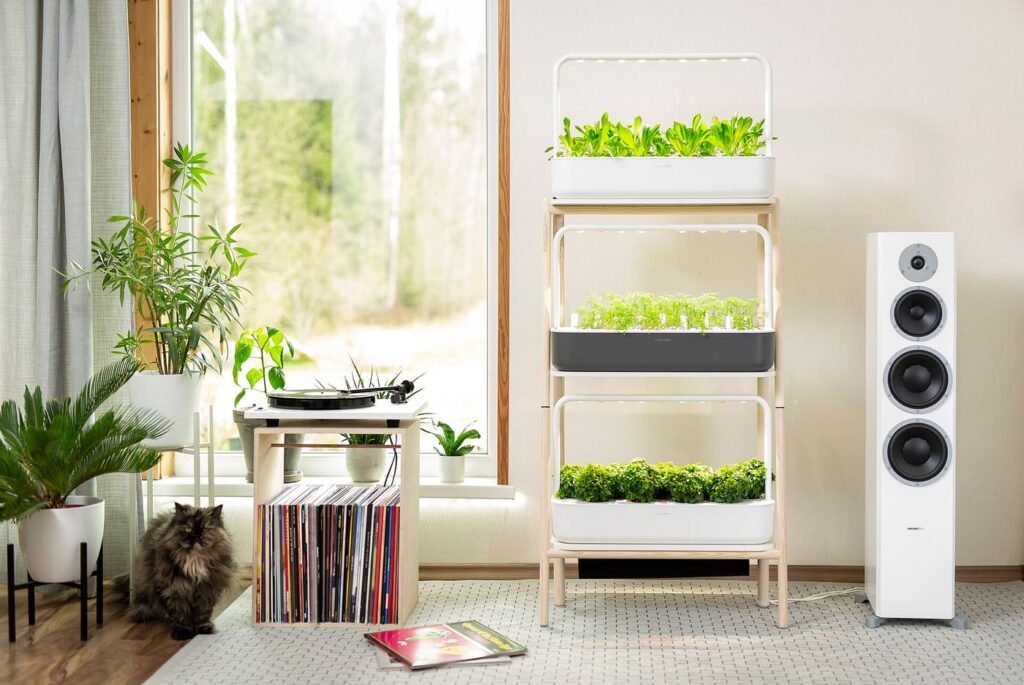
Indoor vegetable gardening works best in winter when you grow leafy greens and microgreens. Give them a bright window or a grow light on a timer, keep the soil from staying soggy, and you can cut fresh leaves all season. Tomatoes and peppers can grow inside too. They need far more light, a deep pot and your help to set fruit.
If you have never grown anything indoors, start with my indoor gardening for beginners guide. For balcony, bucket and container projects, browse the rest of my gardening guides.
Below I sort out the confusing light advice, list the easiest crops with their days to harvest, and walk through the setup step by step. The numbers come from university extension services and the growers’ own guides.
As an Amazon Associate I earn from qualifying purchases.
Key takeaways
- Start with lettuce, spinach, kale, Swiss chard and microgreens. They need the least light and are ready soonest.
- Run grow lights on a timer for a steady 14 to 16 hours a day, then give the plants a full dark period.
- Keep LED lights 6 to 12 inches above the leaves. Most crops like a 60 to 70°F room, but microgreens grow best at 70 to 75°F.
- Water pots when the top inch of soil is dry. Keep shallow microgreen trays evenly moist instead.
- Tomatoes and peppers need the most light, a deep pot, support and hand pollination to set fruit.
Gear for this guide Paid links
As an Amazon Associate I earn from qualifying purchases. Picked from the makers’ published specs, not from testing.
-
Barrina T5 LED Grow Light Strips, 4-PackBest fit. A shelf of greens and seedlings that needs more light than a winter window
-
Espoma Organic Seed Starter Mix, 8 qtHandy extra. Filling shallow microgreen trays and small seedling pots with a light soilless mix
-
AeroGarden Harvest Countertop GardenComplete kit. Herbs and lettuce on a kitchen counter, not root or fruiting crops
In this guide
- Can you really grow vegetables indoors in winter?
- How much light do indoor vegetables need?
- What vegetables grow best indoors?
- How to start an indoor vegetable garden, step by step
- Microgreens: the fastest winter harvest
- Growing tomatoes and peppers indoors
- How to harvest indoor greens so they keep growing
- What to grow next
- Frequently asked questions
Can you really grow vegetables indoors in winter?
Yes, but what you can expect depends on the crop. Light is the main limit indoors in winter. The days are short and window light is weak. So the crops that do well are the ones you eat as leaves.
Here is how I sort indoor crops:
- Easy: lettuce, spinach, kale, Swiss chard and microgreens.
- Possible with some work: radishes and short carrots. They need deeper pots and more light.
- Hard: dwarf tomatoes and small peppers. They need the most light, the longest wait and hand pollination.
If this is your first winter, start with one tray of greens. You will learn your light and your watering habits before you commit to a tomato plant.
How much light do indoor vegetables need?
You will see advice ranging from 4 hours to 20 hours of light a day. The sources mostly agree. They are just talking about different crops and different light sources. This table puts them side by side.
| Situation | Hours of light a day | Source |
|---|---|---|
| Leafy greens and herbs | At least 4 | Bonnie Plants |
| Fruiting crops (peppers) and root crops (beets) | 6 to 8 | Bonnie Plants |
| Young plants under lights | 12 to 14 | Scotts Miracle-Gro |
| Microgreens and baby greens under lights | About 16 | University of Maryland Extension |
| Seedlings under lights | 16 to 18 | University of Vermont Extension |
| Fruiting and root crops under grow lights | 16 to 20 | Scotts Miracle-Gro |
The low numbers are minimums. A winter window may not reach even those. That is why I would plan on a grow light for anything beyond a pot of herbs.
Window light: what to expect from each direction
A south-facing window is best. It gets the most sun through the day.
- East or west windows: these get direct sun for part of the day, in the morning in the east and in the afternoon in the west. Greens and herbs can grow there, just more slowly than in a south window.
- North windows: these get the least light. In winter, a north window is rarely enough for vegetables on its own. Use that spot for a shelf under a grow light instead.
Get more out of the window you have:
- Clean the glass inside and out. Winter grime and condensation marks cut the light that reaches your plants.
- Set the pots as close to the glass as you can, but keep leaves from touching cold panes.
- Put a white surface behind or under the plants, such as a sheet of white poster board. It bounces light back onto the shaded side.
- Turn the pots every few days so they do not lean hard toward the glass.
- Keep plants away from cold drafts and heat vents.
Grow lights: a simple shelf setup
For trays of greens and seedlings, slim LED strip lights over a shelf are the easiest place to start. A set like the Barrina T5 LED grow light strips on Amazon can light a shelf of trays in a spare corner. Keep LEDs 6 to 12 inches above the leaves, as both the University of Maryland Extension and Scotts recommend.
When you compare lights, the University of Vermont Extension suggests a color temperature of about 6500K and a CRI above 85. The Barrina strips are sold as 5000K full spectrum, a little under that figure. Full-spectrum white LEDs in the 5000K to 6500K range are a common choice for leafy greens and seedlings, so a light anywhere in that range will grow a tray of greens. The exact figure matters most when you are comparing several lights side by side.
How many grow light strips do you need?
Size the light to the area you want to grow, not to the number of plants. Here is my starting point for one shelf:
- One tray, all four strips. Put all four 1-foot Barrina strips over a single 10 by 20 inch tray.
- Run them across the short side. Each 1-foot strip is longer than the tray’s 10-inch side, so it spans the tray from edge to edge.
- Space them about 5 inches apart. Spread the four strips evenly along the 20-inch length. That puts the whole surface under light, not just the middle.
- One set per shelf. A second shelf of trays needs its own set of strips.
Then let the plants confirm it. If plants at the edges of the tray lean inward or grow lanky while the center looks fine, move the outer strips closer to the edges or add a strip.
Put the lights on a timer
Plants need darkness too, so UVM advises using a timer. An Ask Extension expert, citing University of Minnesota Extension, recommends 12 to 16 hours of light, ideally a steady 14 to 16, plus 8 to 10 hours of darkness. Setting the timer from 6 am to 10 pm gives you 16 hours.
Can you grow vegetables indoors without grow lights?
You can grow some greens and herbs in a bright south-facing window. Expect slower growth in the short days of winter. Tomatoes and peppers are a long shot without a light. If your home is dark and you mostly want greenery, my guide to low light indoor plants is a better fit than vegetables.
Signs your light is wrong
- Leaves turning brown: the light is too close. Raise it.
- Tall, lanky seedlings: the light is too high. Lower it.
- Pale or yellowing leaves and slow growth: often too little light. Lower the light within the 6 to 12 inch range and check that the timer gives the full hours. Soggy soil can also yellow leaves, so check the pot before you change the light.
What vegetables grow best indoors?
This table pulls together the days to harvest from The Old Farmer’s Almanac and the University of Maryland Extension.
| Crop | Difficulty | Days to harvest | Source |
|---|---|---|---|
| Microgreens | Easy | 7 to 21 | UMD Extension |
| Baby greens | Easy | 21 to 40 | UMD Extension |
| Lettuce | Easy | 30 to 45 | Almanac |
| Spinach | Easy | 30 to 40 | Almanac |
| Kale | Easy | 40 to 60 | Almanac |
| Radishes | Some work | 25 to 35 | Almanac |
| Short carrots | Some work | 60 to 75 | Almanac |
| Dwarf tomatoes | Hard | 60 to 90 | Almanac |
Two more crops, timed by your seed packet:
- Swiss chard (easy): pick it leaf by leaf, like kale.
- Peppers (hard): small varieties such as ‘Mini Bell’ and ‘Lunchbox’ sit with the tomatoes in the hard group.
Both are left out of the table on purpose. Their timing depends on the variety you buy, so take the days to maturity from the packet. For radishes, the Almanac suggests ‘Cherry Belle’ or ‘French Breakfast’.
How to start an indoor vegetable garden, step by step
1. Choose your spot
Pick your brightest window, or a shelf near an outlet if you plan to use lights. Scotts suggests keeping the room at 60 to 70°F. Microgreens are the exception, because they like it warmer. I cover that in the microgreens section below. Make sure you can reach the plants easily, because you will check them often.
2. Pick containers with drainage holes
Every pot needs at least one drainage hole, says Bonnie Plants. Scotts suggests 8-inch pots for many vegetables. Fruiting and root crops need pots at least 8 to 10 inches across, and deep. Baby greens in trays need 2 to 3 inches of soil. For more ways to fit pots into a small room, see my guide to small space container gardening.
3. Fill with a light, soilless mix
For microgreen trays, UMD fills the tray with 1 to 1.5 inches of moist soilless mix. A bag of Espoma Organic Seed Starter mix on Amazon is a soilless mix sold for starting seeds, which suits shallow trays and seedling pots.
For larger pots of lettuce, kale or chard, use a bagged potting mix. Wet the mix before you sow so the seeds sit in even moisture.
4. Or skip soil and grow in water
Bonnie Plants lists growing in water as another route. A countertop hydroponic garden like the AeroGarden Harvest on Amazon holds 6 seed pods and has its own built-in light, so it can sit on a kitchen counter away from a window. It suits herbs and lettuce. It does not grow radishes, carrots, tomatoes or peppers, which need deep pots of soil.
5. Sow, then set the timer
Sow seeds at the depth on the packet. Set your light timer on day one so the plants get the same hours every day. Steady light beats long light one day and short light the next.
6. Water pots when the top inch is dry
Push a finger into the soil. If the top inch is dry, water until a little runs out of the drainage hole. If it is still damp, wait a day and check again. This rule is for pots. Shallow microgreen trays need a different method, which I explain below.
7. Feed lightly, and only the plants that need it
Bonnie Plants says to feed every 7 days, starting about a month after planting. I would not apply that to everything.
- Microgreens and short-cycle baby greens: if you sow them in fresh mix, skip feeding. You cut them before they run short.
- Greens in pots: use a liquid fertilizer mixed at half strength, or weaker than the label rate. Plants grow more slowly under indoor light, so a full-strength feed every week can be more than they use.
- Tomatoes and peppers: these stay in their pots for months, so they are the crops that need regular feeding most. Follow your fertilizer label.
8. Check for pests and keep the air moving
Indoor plants can still get pests. Bonnie names whiteflies, aphids, mealybugs and fungus gnats. Look under the leaves and at the soil surface each time you water, so you catch trouble early.
Still indoor air causes its own problems. A small fan on a low setting near the plants helps leaves and the soil surface dry. That lowers the risk of damping off, where seedlings collapse at the soil line. Fungus gnats breed in soil that stays wet, so letting pots dry at the top between waterings works against them too.
Microgreens: the fastest winter harvest
If you only try one thing this winter, make it microgreens. The UMD guide gives these numbers:
- A 10 by 20 inch tray takes about 1 tablespoon of seed.
- One tablespoon of arugula seed yields 8 to 12 cups of microgreens.
- Microgreens grow best at 70 to 75°F.
- Harvest at 2 to 3 inches tall, which takes 7 to 21 days.
Leave the same tray a little longer and you get baby greens. UMD puts those at 21 to 40 days and 4 to 6 inches tall, and they can regrow one or two times after cutting.
Which seeds to use for microgreens
These are reliable seeds for a first tray:
- Radish
- Broccoli
- Pea shoots
- Sunflower
- Arugula
Buy untreated seed that is sold for sprouting or microgreens. You eat the whole seedling, so skip ordinary garden packets unless they say untreated. Seed sold for microgreens also comes in larger bags, which makes sense when each tray takes a tablespoon or more.
Keep microgreen trays warmer than the room
Here the temperature advice splits. Scotts suggests 60 to 70°F for indoor vegetables in general. UMD says microgreens grow best at 70 to 75°F, which is warmer. Many homes sit at the cool end in winter. Put your trays in the warmest room you have, away from cold glass and drafts, or set them on a seedling heat mat. Keep them off heat vents, which dry a shallow tray fast.
How to water microgreens
The top-inch rule does not work in a tray that only holds 1 to 1.5 inches of mix. By the time the top inch is dry, the whole tray is dry. Do this instead:
- Wet the mix evenly before you sow.
- Mist the surface until the seeds sprout, so they stay damp without washing around.
- Once they sprout, water from below. Set the growing tray, which has drainage holes, inside a solid tray. Pour water into the solid tray, let the mix soak it up, then tip out what is left.
- Aim for evenly moist, never soggy. Standing water and wet leaves invite mold and fungus gnats.
Growing tomatoes and peppers indoors
These are the hard crops. Try them once you have a tray of greens going well. Here is what they need to give you fruit, not just leaves.
Light: the most of any indoor crop
Fruiting crops sit at the top of the light table above. A winter window cannot supply that, so treat a grow light as part of the plan. I would run the timer at the full 16 hours and keep the dark period every night. Raise the light as the plant grows so it stays the same distance above the top leaves.
A deep pot and some support
Use a pot at least 8 to 10 inches across and deep, as the Almanac advises. Pick small varieties such as ‘Tumbling Tom’ or ‘Tiny Tim’ tomatoes and ‘Mini Bell’ or ‘Lunchbox’ peppers. Even small plants can lean or flop once fruit sets. Push a short stake or small cage into the pot early, before the roots fill it, and tie stems loosely with soft ties.
Pollinate the flowers by hand
This is the step most people miss. Outdoors, wind and insects shake pollen loose. Indoors there is neither, so flowers can drop without setting fruit. When flowers open, gently shake the plant or tap the flower stems. You can also touch the center of each open flower with a small, soft paintbrush, moving from flower to flower. Do this regularly while the plant is in bloom.
Then be patient. Dwarf tomatoes take 60 to 90 days to harvest by the Almanac’s count. For peppers, follow the days to maturity on your seed packet.
How to harvest indoor greens so they keep growing
Scotts Miracle-Gro says baby greens are ready in about 3 to 4 weeks and mature greens in 4 to 6 weeks. Harvest leaves once they are 4 inches or longer. Cut about 1 inch above the soil so the plant can push out new leaves.
Pick the outer leaves of lettuce, kale and chard first. The center keeps growing, and you get several small harvests instead of one big one.
What to grow next
Indoor greens are only half of a winter garden. Some cold hardy greens can also grow in pots outside, which I cover in winter container gardening. When spring comes, your indoor seedlings can move out to a balcony vegetable garden.
Frequently asked questions
Do indoor vegetables need grow lights?
Not always. Leafy greens and herbs can grow in a bright south-facing window, though growth is slow in the short days of winter. Tomatoes and peppers need far more light than a winter window gives, so plan on a grow light for them.
Can vegetables be grown indoors year-round?
Yes, especially leafy greens and microgreens under a grow light. A timer gives the plants the same hours of light in December as in June, so the season matters much less. You can sow a new tray every few weeks to keep the harvest going.
How often should I water indoor vegetables?
Water pots when the top inch of soil is dry, and check with your finger rather than watering on a fixed schedule. Microgreen trays are different: keep the shallow mix evenly moist, mist until the seeds sprout, then water from below. Pots with drainage holes let extra water escape so roots do not sit wet.
What size pots do indoor vegetables need?
Scotts suggests 8-inch pots for many vegetables. Fruiting and root crops need pots at least 8 to 10 inches across, and deep. Baby greens grown in trays need only 2 to 3 inches of soil.
What is the easiest vegetable to grow indoors?
Lettuce, spinach, kale, Swiss chard and microgreens are the easiest. Microgreens are the fastest, ready in 7 to 21 days according to the University of Maryland Extension. Lettuce takes about 30 to 45 days.
Why are my indoor tomatoes flowering but not making fruit?
Indoors there is no wind or insects to move pollen, so flowers often drop without setting fruit. Gently shake the plant or tap the flower stems when flowers open, or touch each open flower with a small, soft paintbrush. Make sure the grow light is close to the plant and runs its full hours every day.
Cover photo: Janar Raidla, CC BY-SA 4.0, via Wikimedia Commons