For most trips, the best camping lantern is a rechargeable one. It should have a dim low mode that lasts for days and a bright high mode for cooking. In this list, the BioLite AlpenGlow 500 does both best. For a big group site, the Coast EAL22 is more than twice as bright on high. If the lantern will sit in a closet waiting for a power outage, the UST 60-Day DURO runs for weeks on its lowest setting.
I sorted these seven by how people actually camp: from the car, from a backpack, inside the tent, and at home when the power goes out. Each pick is labeled with its job. Below the picks, a table puts each lantern’s brightest and lowest settings side by side so you can compare runtimes fairly. For the rest of my camp gear notes, start at my camping section.
As an Amazon Associate I earn from qualifying purchases.
Key takeaways
- Pick by the setting you will use most, not the biggest lumen number.
- Rechargeable suits weekend trips. D cells suit a closet emergency kit.
- Only the LuminAID Titan is rated for immersion. The rest handle splashes.
- A red light mode protects your night vision on late walks.
- Never run a propane lantern inside a tent, even with the flaps open.
In this guide
- How I compared these camping lanterns
- Camping lanterns side by side
- Which camping lantern fits how you camp?
- What about a cheap camping lantern?
- Rechargeable, D batteries or propane?
- Warm, cool or red light?
- What IPX4, IP54 and IP67 mean at camp
- How to light your campsite without blinding your neighbors
- Frequently asked questions
How I compared these camping lanterns
I compared what each maker publishes: brightness at each setting, runtime, battery size, how it charges, water rating, weight and warranty. Then I read owner manuals, warranty terms and verified buyer feedback to find the complaints that keep coming up. I haven’t owned or used these lanterns myself. Each pick below lists specs from the maker’s own page and one honest downside.
I also sorted the lanterns by job. A lantern that works well inside a tent can be useless for lighting a picnic table for six people. Brightness matters. How long the light lasts on the setting you actually use matters more.
As an Amazon Associate I earn from qualifying purchases.
BioLite AlpenGlow 500: Best Overall Rechargeable
Best for: Car campers who want one rechargeable lantern that does everything
- Brightness: 500 lm high, 5 lm low
- Runtime: 5 h high, 200 h low
- Power: 6400 mAh (23.6 Wh) battery, micro-USB, about 3 h to charge
- Water rating: IPX4
- Weight: 13.4 oz
- Extras: USB-A out 5V/2.4A, CRI 90
The catch: Only 5 hours on high, and it charges over micro-USB, not USB-C.
Coleman Classic Recharge 800L: Best for Family Car Camping
Best for: Family car camping and lighting a camp kitchen
- Brightness: 800 / 300 / 100 lm
- Runtime: 5 / 15 / 45 h
- Power: 4800 mAh Li-ion battery, USB-C charging
- Water rating: IPX4
- Weight: 2.26 lb
- Extras: USB-A port charges other devices
The catch: The heaviest of the built-in battery picks, and Coleman says it is water-resistant only, not waterproof.
Coast EAL22: Best for Big Group Sites
Best for: Big group sites that need bright light on D cells or a rechargeable pack
- Brightness: 1250 / 640 / 95 lm
- Runtime: 9 / 17 / 135 h
- Power: 3 D batteries or ZX1010 rechargeable pack, both sold separately
- Water rating: IPX4 or IP54
- Weight: 34.6 oz
- Extras: Warm or cool white, red, flashing red
The catch: Batteries are not included, and the rechargeable pack is sold separately.
UST 60-Day DURO LED Lantern: Best for Emergency Kits
Best for: Home emergency kits and long trips without charging
- Brightness: 1200 / 200 / 20 lm
- Runtime: Up to 41 h / 192 h / up to 60 days
- Power: 6 D batteries, not included
- Water rating: IPX4
- Weight: 1.1 lb; 3.1 lb with batteries
- Extras: SOS mode up to 15 days, three Nichia LEDs
The catch: Needs 6 D batteries, which are not included and add real weight.
Black Diamond Moji R+: Best for Backpacking
Best for: Backpackers who want the lightest lantern for one tent
- Brightness: 150 lm
- Runtime: 5.5 h high, 16 h low
- Power: 1500 mAh battery, micro-USB
- Water rating: IPX4
- Weight: 6 oz (170 g)
The catch: The dimmest top output here, and it lasts only 5.5 hours on high from a small 1500 mAh battery.
LuminAID PackLite Titan 2-in-1: Best Inflatable and Waterproof
Best for: Tent light, wet trips and charging a phone off grid
- Brightness: 300 lm max
- Runtime: Up to 100 h on low
- Power: 4000 mAh battery, charges a phone 2 to 3 times
- Water rating: IP67
- Weight: 12.5 oz
- Extras: Red mode, twist to inflate
The catch: At 300 lumens it suits a tent better than a whole campsite.
Coleman NorthStar 1500 Propane Lantern: Brightest Pick
Best for: Lighting a large open campsite, outdoors only
- Brightness: Up to 1500 lm
- Runtime: 4 h high, 9 h low on a 16.4 oz cylinder
- Power: Propane, cylinder sold separately
- Extras: Beam distance 26 m (about 85 ft)
The catch: It burns propane, so it is strictly an outdoor light, and owners on Coleman’s site report fragile mantles.
Camping lanterns side by side
| Lantern | Brightest setting | Lowest setting | Weight | Water rating |
|---|---|---|---|---|
| BioLite AlpenGlow 500 | 500 lm for 5 h | 5 lm for 200 h | 13.4 oz | IPX4 |
| Coleman Classic Recharge 800L | 800 lm for 5 h | 100 lm for 45 h | 2.26 lb | IPX4 |
| Coast EAL22 | 1250 lm for 9 h | 95 lm for 135 h | 34.6 oz | IPX4 or IP54 |
| UST 60-Day DURO | 1200 lm, up to 41 h | 20 lm, up to 60 days | 1.1 lb, 3.1 lb with batteries | IPX4 |
| Black Diamond Moji R+ | 150 lm for 5.5 h | Low mode for 16 h | 6 oz | IPX4 |
| LuminAID PackLite Titan 2-in-1 | 300 lm | Low mode for up to 100 h | 12.5 oz | IP67 |
The lowest settings run from 5 to 100 lumens, so a long runtime on low is not always the better deal. Compare runtimes at similar brightness. The Coast keeps 95 lumens going for 135 hours, while the Coleman gives 100 lumens for 45 hours. The UST also has a 200 lumen setting that runs for 192 hours.
Read the UST’s top figure carefully. UST says up to 41 hours at 1200 lumens, and “up to” is a best case. Don’t plan an outage around 41 hours of full brightness. Use the 200 lumen setting for most of the evening and keep a spare set of D cells in the drawer.
The propane Coleman NorthStar 1500 is left out of the table. Its runtime depends on the fuel cylinder, not a battery, so it doesn’t compare directly.
Which camping lantern fits how you camp?
Car camping and family campsites
When the car carries everything, weight hardly matters. Pick the lantern that runs longest at a useful brightness. The AlpenGlow 500 and the Coleman Classic Recharge both fit here. The Coleman has more top-end light, at 800 lumens. The BioLite weighs 13.4 oz against the Coleman’s 2.26 lb. It also has a CRI of 90, so food and faces look closer to their real colors. If you are still planning your site, my car camping setup guide shows where a lantern fits. My camping kitchen setup post covers lighting the cooking area.
Backpacking
On your back, every ounce counts and you rarely need much light. The Black Diamond Moji R+ is the lightest lantern here. Black Diamond’s own pages give two sets of figures for it: 150 or 200 lumens, and 86 or 170 grams. I use the dimmer, heavier pair, 150 lumens and 6 oz, everywhere in this post. Even at those numbers it is still the lightest pick. The LuminAID PackLite Titan weighs 12.5 oz. You twist it to inflate it, and it packs flat, so it takes less room than a rigid lantern. For the extra weight you get 300 lumens and a 4000 mAh battery that can also charge your phone.
Inside the tent
Inside a tent you want low, soft light, not a floodlight. The AlpenGlow drops to 5 lumens, which is enough to find a sleeping bag zipper without waking anyone. The Moji R+ runs 16 hours on low. The LuminAID has a red mode and an IP67 rating, so condensation and a spilled water bottle are not a worry. My tent camping checklist lists the rest of what goes in the tent with you.
Power outages and emergency kits
A rechargeable lantern left in a closet for a year may be flat when you need it. D-cell lanterns get around that, because you can keep fresh batteries in a drawer. The UST 60-Day DURO is built for this job. It runs up to 60 days on its lowest setting, and its SOS mode runs for up to 15 days. The Coast EAL22 also runs on D cells. It can take Coast’s ZX1010 rechargeable pack too, which gives you both options. For longer outages, a lantern pairs well with one of the solar generators for camping I’ve compared.
Lighting a big group site
For a long table or a big open site, you need real output. The Coast EAL22 reaches 1250 lumens on batteries, and the UST reaches 1200. The Coleman NorthStar 1500 goes brighter on propane, and Coleman lists a beam of 26 meters, about 85 feet. Read the propane section below before you choose it.
What about a cheap camping lantern?
This list skips budget models on purpose. Every lantern here comes from a maker that publishes runtimes and water ratings, and those numbers are what let you compare one lantern with another. A cheap lantern or multi-pack can still be fine for a kids’ tent or a backup in the glovebox. Before you buy one, check three things:
- A stated runtime on the low setting, with its lumens.
- At least an IPX4 water rating.
- A charging port or battery size you already have.
If a listing doesn’t give those numbers, you have no way to judge it against the lanterns above.
Rechargeable, D batteries or propane?
Rechargeable lanterns mean no batteries to buy. You top them up from the car or a power bank. The catch is that once the battery is empty, you wait for a recharge. If you charge several things at camp, my guide to power banks for camping helps you size one.
D-cell lanterns need batteries, but you can swap in fresh ones anywhere, at any time. Neither the Coast nor the UST includes batteries, so buy them with the lantern. Six D cells also add real weight to the UST.
Propane gives the most light in this list. The NorthStar 1500 runs about 4 hours on high from a 16.4 oz cylinder, so pack spares for a long weekend. Fuel-burning lanterns also make carbon monoxide. The U.S. Consumer Product Safety Commission warns never to use fuel-burning camping equipment inside a tent, camper or other enclosed shelter. An older CDC report found that opening the tent flaps does not prevent carbon monoxide from building up. Keep a propane lantern outside, on a stable surface, well away from tent walls.
Power, charging and light levels for each lantern
| Lantern | Power and charging | Published light levels |
|---|---|---|
| BioLite AlpenGlow 500 | 6400 mAh battery, micro-USB, about 3 h to charge | 500 lm high, 5 lm low |
| Coleman Classic Recharge 800L | 4800 mAh Li-ion battery, USB-C | 800, 300 and 100 lm |
| Coast EAL22 | 3 D cells or ZX1010 rechargeable pack | 1250, 640 and 95 lm, plus red and flashing red |
| UST 60-Day DURO | 6 D cells | 1200, 200 and 20 lm, plus SOS |
| Black Diamond Moji R+ | 1500 mAh battery, micro-USB | High and low, 150 lm max |
| LuminAID PackLite Titan 2-in-1 | 4000 mAh battery | Up to 300 lm, plus red |
| Coleman NorthStar 1500 | 16.4 oz propane cylinder | Up to 1500 lm, high and low |
Check the charging port named on the listing when you order, and pack the matching cable. A micro-USB lantern and a USB-C phone need two different cords.
Warranties differ a lot. Coleman lists a 3-year limited warranty on the Classic Recharge and a 5-year warranty on the NorthStar 1500. UST lists a limited lifetime warranty on the 60-Day DURO. For the other picks, read the warranty terms on the maker’s page before you buy.
Three small things decide whether people keep a lantern, so look for them in the manual of the one you pick:
- How it hangs. A top hook or loop hangs from a tent’s ceiling loop or a low branch. A flat base needs a level table.
- A battery gauge. A few lit dots tell you to recharge before the light dies mid-dinner.
- Running while charging. If you plan to run a rechargeable lantern off a power bank overnight, make sure it stays on while plugged in.
Warm, cool or red light?
Cool white light looks crisp and bright. Warm light is softer and has less glare when you’re sitting around the table. The Coast EAL22 lists both warm and cool white. If you have a strong preference, check the mode list on the maker’s page for the lantern you are looking at.
Red light is worth having for night trips to the restroom and for stargazing. Mesa Verde National Park’s stargazing advice recommends red light so your eyes stay adjusted to the dark. Two picks here list a red night mode: the Coast EAL22, with red and flashing red, and the LuminAID Titan. If red light matters to you and you want a different pick, confirm it on that lantern’s mode list first. If your lantern has no red mode, use the lowest setting, point it at the ground, or carry a headlamp with a red mode.
What IPX4, IP54 and IP67 mean at camp
Most lanterns here are rated IPX4. That means they handle splashes and rain from any direction. It does not mean you can drop them in a lake. Coleman’s own support team describes the Classic Recharge as water-resistant, not waterproof. Coast lists the EAL22 as IPX4 on one page and IP54 on another. IP54 adds some protection against dust. For water, both ratings mean splash resistance, so treat the Coast like the others in the rain. The LuminAID Titan is rated IP67, which means it is sealed against dust and rated for temporary immersion. That makes it the safest pick for boat trips, kayak camping or a wet tent floor.
How to light your campsite without blinding your neighbors
Bright lanterns are easy to overdo at a crowded campground. The National Park Service’s outdoor lighting principles come down to this: use light only where and when you need it, shield it, and keep it to the least you need. At camp, that means a few simple habits:
- Hang the lantern low over the table, not high on a pole.
- Use the low setting once dinner is done.
- Turn it off when you go to bed, rather than leaving it glowing toward the next site.
- Use red mode, or your dimmest setting, for late walks to the restroom.
Your neighbors sleep better, you see more stars, and your battery lasts longer.
Frequently asked questions
How many lumens do I need for a camping lantern?
It depends on the job. Inside a tent, a low setting like the AlpenGlow’s 5 lumens or the Coleman’s 100 lumens lets you find gear without glare. For a whole group site, the 1200 lumen and brighter settings on the UST, the Coast and the NorthStar make more sense.
Can a camping lantern charge my phone?
Some can. The BioLite AlpenGlow 500 and the Coleman Classic Recharge both have a USB-A port for other devices, and LuminAID says the Titan’s battery charges a phone 2 to 3 times. Every charge you give your phone comes out of the lantern’s own runtime, so top up the phone early and save the lantern for the evening.
Do solar camping lanterns actually work?
They work best as a top-up, not as your only way to charge. Charge the lantern fully over USB before you leave, then lay the panel in direct sun during the day. Check the maker’s stated solar charge time so you know how many sunny hours a full charge takes.
Do I need a lantern if I have a headlamp?
I’d carry both. A headlamp lights wherever you look and keeps your hands free on the trail. A lantern lights the whole table or tent, so everyone can see without shining a beam in each other’s eyes.
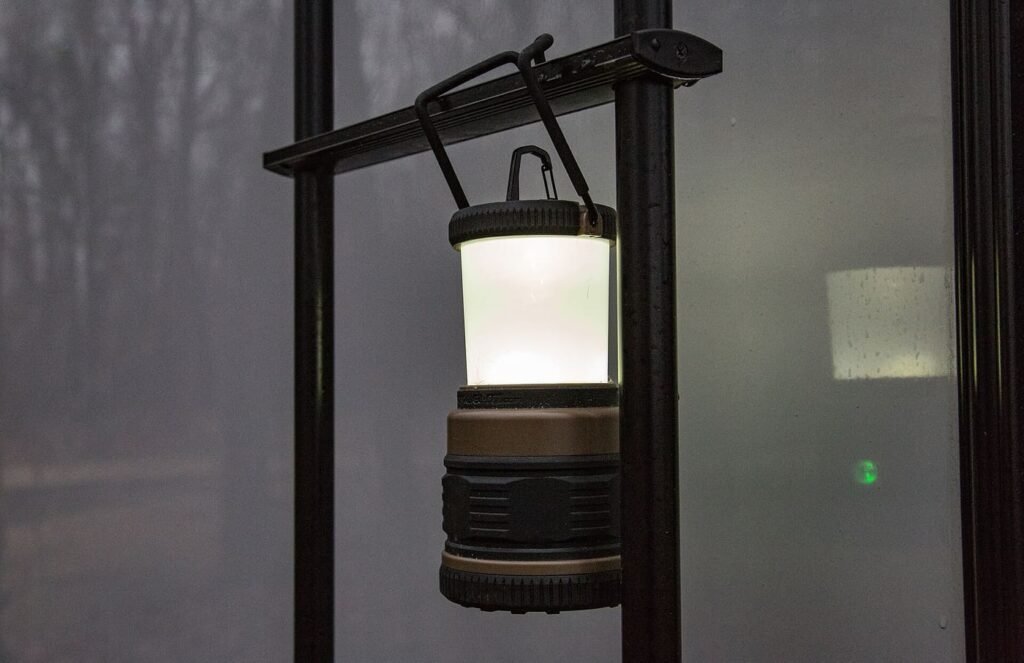
Cover photo: Tony Webster from Minneapolis, Minnesota, United States, CC BY 2.0, via Wikimedia Commons