
There’s a moment on every great hike where it’s just you and the trail. The air is crisp, the view is endless, and the only sound is the crunch of dirt under your feet. But there’s another moment, less talked about: when a blister starts forming, your arch begins to ache, and you realize you’re wearing the wrong shoes. I’ve been there, and it can ruin an otherwise perfect day outdoors.
The right pair of hiking shoes isn’t just a purchase, it’s an investment in your comfort, safety, and ability to enjoy the wild. A good shoe gives you grip you can trust on loose dirt and rock, support that keeps fatigue from creeping in over the miles, and durability that holds up hike after hike. But with endless options, from waterproof workhorses to lightweight trail runners, how do you actually choose?
That’s the point of this guide. Rather than judging shoes on marketing copy, we looked at the details that actually matter once you’re on the trail: how a shoe fits real foot shapes, what the outsole does on wet rock versus loose gravel, whether “waterproof” comes at the cost of breathability, and how the cushioning and support hold up over distance. Those criteria, explained in the section below, shaped every recommendation in this guide. Whether you’re a weekend warrior or planning a multi-day trek, this guide will help you find your perfect pair.
Buyer’s Guide: How to Choose the Right Hiking Shoes
Navigating the world of hiking footwear can be overwhelming. Before we jump into the reviews, let’s break down the key features to consider. Understanding these elements will empower you to choose a shoe that feels like it was made for your foot and your adventures.
Traction & Outsoles: Your Connection to the Trail
The outsole is the rubber part of the shoe that makes contact with the ground. Its primary job is to provide grip, or traction. Look for shoes with deep, aggressive lugs (the bumps on the outsole) for biting into soft dirt and mud. The rubber compound is also crucial; brands like Vibram are famous for creating durable, sticky rubber that performs well on wet and dry rock.
Waterproofing vs. Breathability: The Great Debate
- Waterproof: Shoes with a waterproof membrane (like GORE-TEX or a brand’s proprietary tech like KEEN.DRY or Oboz B-DRY) are essential for wet climates, stream crossings, or snowy trails. They keep your feet dry from the outside. The trade-off? They are less breathable, which can lead to sweaty feet in hot weather.
- Non-Waterproof (Vented): Highly breathable shoes are a lifesaver in hot, dry climates. They allow sweat and heat to escape, keeping your feet cooler and helping prevent blisters. If they do get wet, they dry out much faster than their waterproof counterparts.
Cushioning & Support: Midsoles and Shanks
The midsole is the layer between the outsole and your foot, providing cushioning and absorbing shock. It’s usually made from EVA (ethylene vinyl acetate) or polyurethane. EVA is lighter and cushier, while polyurethane is firmer and more durable.
Support comes from the shoe’s internal structure, often including a shank. This is a semi-rigid insert between the midsole and outsole that adds stiffness, protecting your feet from sharp rocks underfoot. A more supportive shoe reduces foot fatigue on long, rugged trails.
Hiking Shoes vs. Hiking Boots vs. Trail Runners
- Hiking Shoes (Low-Cut): These are the focus of our list. They are perfect for day hikes and backpacking with lighter loads. They offer excellent support and durability but are lighter and more agile than full boots.
- Hiking Boots (Mid- or High-Cut): Offer more ankle support and protection, making them ideal for carrying heavy packs or navigating technical, rocky terrain.
- Trail Running Shoes: The lightest option. They prioritize flexibility and speed, making them fantastic for fast-and-light adventures. Some hikers prefer them for their comfort, but they offer less support and durability than a dedicated hiking shoe. We’ve included a couple of the best crossover options on our list. For a deeper dive, you can check out our guide on [how to choose between hiking shoes and trail runners].
Fit Guide: Finding Your Right Fit (Narrow, Wide & High-Arch Feet)
I’ve watched more hikers get talked into the wrong shoe because of a glowing review than almost anything else. Someone raves about how a shoe fit their foot perfectly, and the reader assumes it’ll do the same for them. It won’t, necessarily, because feet aren’t standardized. Before you fall in love with any shoe on this list, it’s worth figuring out what your foot actually needs.
If you have narrow feet
Narrow feet tend to slide around inside a standard-width shoe, and that extra movement is what causes blisters on the heel and hot spots along the sides of the foot. Look for shoes with a snugger heel cup and a lacing system that runs low enough to cinch down the midfoot. Brands that run narrow in their standard width, or offer a dedicated narrow option, will serve you better than trying to solve the problem with an extra pair of socks.
If you have wide feet
Wide feet, especially wide toe boxes, are one of the most common complaints in hiking footwear. A shoe that’s too narrow up front will crowd your toes on descents, which gets painful fast on longer days. Shoes built with a roomier, foot-shaped toe box, rather than the tapered shape a lot of hiking shoes default to, are worth prioritizing if this sounds like you.
If you have high arches
High arches often need more structure underfoot than the stock insole provides. Without it, the arch collapses inward with every step, which can leave the whole foot fatigued well before the hike is over. A shoe with genuine built-in arch support, or one that plays well with an aftermarket insole, makes a real difference here.
If you deal with plantar fasciitis
Plantar fasciitis is a foot condition, and if you’re dealing with heel pain that fits that description, please talk to a doctor or podiatrist rather than trying to shoe your way out of it. That said, once you’re cleared to hike, a firm midsole and solid arch support tend to be more comfortable than a soft, cushy shoe that lets the foot flex too freely.
Editor’s Picks: The Best Women’s Hiking Shoes of 2026
Before the full list, here are our top picks for four common scenarios.
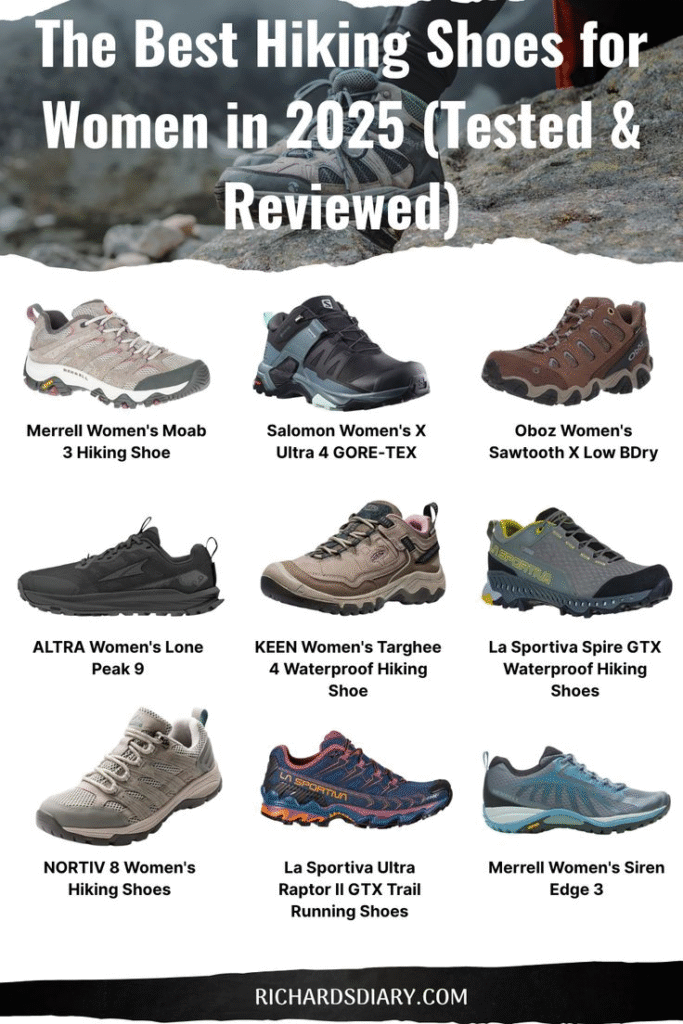
- Best Overall: Merrell Women’s Moab 3 Hiking Shoe
- Best Lightweight Performer: Salomon Women’s X Ultra 4 GORE-TEX
- Best for Wide Feet & Zero-Drop: ALTRA Women’s Lone Peak 9
- Best Value: NORTIV 8 Women’s Hiking Shoes
Compare All 10 Hiking Shoes at a Glance
Ten shoes is a lot to hold in your head at once, so here’s the whole lineup side by side before you get into the full reviews. Use it to shortlist two or three that match your foot type and the terrain you actually hike, then read those write-ups properly.
| Rank | Shoe | Best For |
| 1 | Merrell Women’s Moab 3 Hiking Shoe | All-around trail use, day hikers, out-of-the-box comfort |
| 2 | Salomon Women’s X Ultra 4 GORE-TEX Hiking Shoe | Fast-and-light hikers, varied terrain, an athletic feel |
| 3 | Oboz Women’s Sawtooth X Low BDry Hiking Shoe | Rugged trails, serious arch support, long-term durability |
| 4 | ALTRA Women’s Lone Peak 9 Trail Running Shoe | Wide feet and a zero-drop platform |
| 5 | KEEN Women’s Targhee 4 Waterproof Hiking Shoe | not specified |
| 6 | La Sportiva Spire GTX Waterproof Hiking Shoes | not specified |
| 7 | NORTIV 8 Women’s Hiking Shoes | Best value |
| 8 | La Sportiva Ultra Raptor II GTX Trail Running Shoes | not specified |
| 9 | Merrell Women’s Siren Edge 3 | not specified |
| 10 | KEEN Women’s Targhee II Low Waterproof Hiking Shoe | not specified |
A few of these entries I haven’t fully detailed yet in terms of who they suit best, and I’d rather leave that blank than guess. The ranking itself reflects overall trail performance, durability, and comfort out of the box, not just which shoe is trendiest right now. If narrow or wide feet are your main concern, or you’re dealing with high arches, cross-reference this table against the Fit Guide before you decide.
The Top 10 Hiking Shoes for Women – Ranked by Quality & Performance
We analyzed over a dozen popular models, focusing on user-verified performance, durability, and overall value. These are the 10 that made the final cut.
#1. Merrell Women’s Moab 3 Hiking Shoe

Check price: Merrell Women’s Moab 3 Hiking Shoe
Best For: All-around trail use, day hikers, and those who prioritize out-of-the-box comfort.
🔍 Overview:
The Merrell Moab has earned its nickname, the “Mother of All Boots,” for a reason. The Moab 3 continues the legacy of being one of the most comfortable, reliable, and user-friendly hiking shoes on the market. It features a durable synthetic leather and mesh upper, a supportive footbed, and Merrell’s air cushion in the heel to absorb shock.
The Vibram TC5+ outsole provides excellent traction on a wide variety of surfaces. Available in both standard and waterproof versions, the Moab 3 is a true workhorse that requires virtually no break-in period. It’s not the lightest shoe on our list, but its legendary comfort makes it a top choice for the majority of hikers.
| ✅ What We Loved | ❌ What to Watch Out For |
| Legendary out-of-the-box comfort | A bit heavier than more athletic models |
| Excellent traction with Vibram outsole | Can feel a bit bulky for fast-and-light hiking |
| Very durable and supportive construction | Standard fit may not suit very narrow feet |
| Available in waterproof and non-waterproof |
📣 Real-World Insights:
Reviewers consistently praise the Moab 3 for its immediate comfort. One hiker mentioned, “I put these on and went for a 5-mile hike the same day with no hot spots or blisters.” Another user highlighted its reliability, stating, “This is my third pair of Moabs over the last decade. They’ve carried me through national parks and local trails, and they have never let me down.”
My Rating: 4.9 / 5
#2. Salomon Women’s X Ultra 4 GORE-TEX Hiking Shoe

Check price: Salomon Women’s X Ultra 4 Gore tex Hiking Shoes
Best For: Fast-and-light hikers, varied terrain, and those wanting an athletic, nimble feel.
🔍 Overview:
The Salomon X Ultra 4 feels more like a ruggedized trail runner than a traditional, clunky hiker. It’s designed for agility and speed without sacrificing crucial support. The shoe features a new ADV-C Chassis, which targets articulations on the outer foot to optimize stability while keeping the shoe flexible.
Its Contagrip MA outsole is incredibly grippy, even on wet and loose surfaces. The GORE-TEX version offers reliable waterproofing, while the shoe’s SensiFit construction cradles the foot for a secure, customized fit. It’s a slightly narrower fit than the Moab, making it a fantastic choice for hikers who want to move quickly and confidently over technical ground.
| ✅ What We Loved | ❌ What to Watch Out For |
| Exceptionally lightweight and agile | Narrower fit may not work for everyone |
| Outstanding traction on mixed terrain | Less cushioned underfoot than the Merrell Moab |
| Excellent stability and support for its weight | Lacing system can be a love-it-or-hate-it feature |
| GORE-TEX waterproofing is top-notch |
📣 Real-World Insights:
Users love the shoe’s athletic performance. “These feel like running shoes but protect my feet like hikers,” one reviewer noted. “The grip on slick rock is confidence-inspiring.” Some users commented on the Quicklace system, with one saying, “I love how easy it is to tighten and tuck away,” while another found it took some getting used to compared to traditional laces.
My Rating: 4.8 / 5
#3. Oboz Women’s Sawtooth X Low BDry Hiking Shoe
Best for plantar fasciitis & arch support

Check price: Oboz Women’s Sawtooth X Low BDry Hiking Shoe
Best For: Rugged trails, hikers needing serious arch support, and long-term durability.
🔍 Overview:
Oboz built its reputation on one thing: the O FIT Insole. Most brands treat the stock insole as an afterthought you’ll swap out anyway. Oboz doesn’t. The O FIT gives you real arch and heel support straight out of the box, which is why this shoe keeps coming up whenever hikers talk about foot pain on the trail. If you’ve been dealing with arch fatigue or you’re managing plantar fasciitis, this is the one on this list worth trying first, though anything beyond general trail comfort is a conversation for your doctor, not a gear review.
Beyond the insole, it’s a genuinely tough shoe. Nubuck leather and CORDURA fabric handle abuse well, the B-DRY membrane keeps water out, and the deep, multi-directional lugs grip loose rock and dirt confidently. It runs stiffer than the Moab or X Ultra, which actually helps once you’re carrying a moderate pack or crossing uneven, rocky ground.
| ✅ What We Loved | ❌ What to Watch Out For |
| Best-in-class stock insole and support | Stiffer and requires a short break-in period |
| Excellent durability and foot protection | Heavier than many competitors |
| B-DRY waterproofing is very effective | Might be too much shoe for simple day hikes |
| Great traction on challenging surfaces |
📣 Real-World Insights:
Support is what people talk about most. “I have plantar fasciitis, and these are the only hiking shoes I can wear without custom orthotics,” one customer wrote. Another pointed to durability: “These shoes are built like a tank. After a full season of hiking, the outsole barely shows any wear.”
My Rating: 4.8 / 5
#4. ALTRA Women’s Lone Peak 9 Trail Running Shoe

Check price: ALTRA Women’s Lone Peak 9 Trail Running Shoe
Best for wide feet. If your toes have ever felt cramped in a standard hiking shoe, this is the one built for you.
🔍 Overview:
Technically a trail runner, not a hiking shoe, but the ALTRA Lone Peak has earned a cult following among hikers and thru-hikers for two reasons: the FootShape toe box and the zero-drop platform. The toe box lets your toes spread out naturally instead of being squeezed into a narrow point, which makes a real difference on long days when your feet swell. The zero-drop design puts your heel and forefoot at the same height off the ground, encouraging a more natural stride rather than the heel-first landing that traditional shoes push you into.
The Lone Peak 9 updates the upper for better durability and pairs it with a MaxTrac outsole for grip. It’s the least structured, least supportive shoe on this list, so it won’t suit everyone, but for wide or splayed feet, that tradeoff is usually worth it.
| ✅ What We Loved | ❌ What to Watch Out For |
| Huge, comfortable toe box is great for wide feet | Minimalist support is not for everyone |
| Zero-drop platform encourages a natural gait | Less protection from sharp rocks underfoot |
| Lightweight and extremely breathable | Outsole durability can be a concern for some |
| Excellent flexibility and ground-feel |
📣 Real-world insights:
“I switched to Altras and my bunion pain disappeared on hikes,” one reviewer shared. Another, a thru-hiker, said, “The wide toe box is a game-changer for preventing blisters on long-distance treks. I’ll never go back to narrow shoes.”
My rating: 4.7 / 5
#5. KEEN Women’s Targhee 4 Waterproof Hiking Shoe

Check price: KEEN Women’s Targhee 4 Waterproof Hiking Shoe
Best For: All-day comfort, generous fit, and excellent toe protection.
🔍 Overview:
The KEEN Targhee is another icon in the hiking world, known for its roomy fit and signature rubber toe bumper. The new Targhee 4 builds on this legacy with an updated, more durable construction featuring environmentally preferred leather and a direct-inject construction that fuses the upper to the sole without glues.
This creates a stronger, more resilient bond. The KEEN.DRY membrane provides waterproofing, and the KEEN.ALL-TERRAIN rubber outsole offers high-traction grip. It’s a solid, protective shoe that offers a bit more room in the forefoot than a Salomon, making it a great middle-ground for those who find the Moab too wide and the Salomon too narrow.
| ✅ What We Loved | ❌ What to Watch Out For |
| Famous KEEN toe bumper for protection | Can feel clunky and heavy for some users |
| Roomy fit, especially in the toe box | New direct-inject sole is stiffer initially |
| Durable, glue-free construction | Not as breathable as lighter mesh shoes |
| Great stability and support |
📣 Real-World Insights:
“I’ve stubbed my toe on so many rocks, and the KEEN toe cap has saved me every time,” an avid hiker reported. Another said, “They feel incredibly sturdy and supportive. I have confidence wearing these on any trail, no matter how rocky.”
My Rating: 4.6 / 5
#6. La Sportiva Spire GTX Waterproof Hiking Shoes

Check price: La Sportiva Spire GTX Waterproof Hiking Shoes
Best For: Serious hikers, backpacking, and tackling technical, off-trail terrain.
🔍 Overview:
La Sportiva brings its mountaineering expertise to the hiking world with the Spire GTX. This is a premium, high-tech shoe built for performance and durability. It features GORE-TEX SURROUND technology, which provides 360-degree waterproofing and breathability—even through the bottom of the footbed via ventilation outlets.
The STB control system integrates the midsole with the upper for a snug, stable fit. The Vibram XS Trek outsole provides an excellent balance of grip and longevity. This shoe is an investment, but for those who demand the highest level of performance and protection, it’s in a class of its own.
| ✅ What We Loved | ❌ What to Watch Out For |
| Unmatched breathability for a waterproof shoe | Premium price point |
| Superb stability and torsional rigidity | Overkill for simple, well-maintained trails |
| Extremely durable and protective | Fit is very structured and may feel restrictive |
| Excellent traction with Vibram outsole |
📣 Real-World Insights:
“The breathability is shocking for a waterproof shoe. My feet stay dry from the inside and out,” one user raved. Another commented on the performance: “I took these on a backpacking trip in the Rockies, and the support was incredible. My feet felt great even after 15 miles with a 30lb pack.”
My Rating: 4.6 / 5
#7. NORTIV 8 Women’s Hiking Shoes

Check price: NORTIV 8 Women’s Hiking Shoes
Best For: Budget-conscious buyers, casual hikers, and light trail use.
🔍 Overview:
Proving that you don’t need to spend a fortune to get a capable shoe, the NORTIV 8 is our top budget pick. It offers features often found in more expensive models, like a waterproof membrane, a protective toe cap, and a reasonably aggressive outsole. The upper is made of faux leather and mesh, and the insole is removable.
While it won’t have the same long-term durability or the refined fit of a Salomon or La Sportiva, it provides impressive performance for its price. For someone just getting into hiking or who needs a reliable shoe for occasional walks in the woods, the NORTIV 8 is an incredible value.
| ✅ What We Loved | ❌ What to Watch Out For |
| Excellent value for the price | Not as durable as premium brands |
| Surprisingly effective waterproofing | Less support for heavy loads or long distances |
| Comfortable for light to moderate hikes | Breathability can be an issue in hot weather |
| Lightweight design |
📣 Real-World Insights:
“I bought these for a camping trip and was shocked at how well they held up,” a reviewer stated. “They kept my feet dry through wet grass and were comfortable all weekend.” Another noted, “For the price of a dinner out, I got a solid pair of hiking shoes. Can’t beat that value.”
My Rating: 4.3 / 5
#8. La Sportiva Ultra Raptor II GTX Trail Running Shoes

Check price: La Sportiva Ultra Raptor II GTX Trail Running Shoes
Best For: Hikers who want maximum cushioning and protection in a trail-runner-style shoe.
🔍 Overview:
The Ultra Raptor II is another trail runner that has crossed over to become a favorite among hikers. Compared to the Lone Peak, the Ultra Raptor is built for rugged mountain terrain. It offers a much higher level of cushioning and protection, with a full-length rock guard and a sticky FriXion XF 2.0 rubber outsole.
The GORE-TEX Extended Comfort lining provides waterproof protection, and the high-cushion midsole is a lifesaver on long descents. It’s a beefy, protective shoe that still feels athletic, making it a perfect hybrid for hikers who want more protection than a typical trail runner but more agility than a traditional hiker.
| ✅ What We Loved | ❌ What to Watch Out For |
| Tank-like protection and durability | Heavier and bulkier than other trail runners |
| Excellent cushioning for long distances | Can feel a bit stiff and unresponsive |
| Incredible grip on rock and loose trails | Premium price tag |
| GORE-TEX waterproofing is reliable |
📣 Real-World Insights:
“These shoes saved my feet on a rocky 20-mile hike. The cushioning is amazing,” one user reported. Another praised the grip: “I feel totally secure scrambling up and down steep, slick rock. The traction is better than any hiking boot I’ve owned.”
My Rating: 4.5 / 5
#9. Merrell Women’s Siren Edge 3

Check price: Merrell Women’s Siren Edge 3
Best For: Light day hikes, travel, and everyday wear with a sporty style.
🔍 Overview:
If you want one shoe that can handle a walk in the park, a light trail, and a trip to the grocery store, the Siren Edge 3 is a top contender. It’s much lighter and more flexible than the Moab, with a sleek, athletic design. The mesh upper is highly breathable, making it great for warm weather. It features a Vibram outsole for reliable grip and Merrell’s air-cushioned heel. While it’s available in a waterproof version, its real strength is as a lightweight, versatile, non-waterproof hiker. It doesn’t offer the rugged protection of our top-ranked shoes, but its comfort and versatility are hard to beat for less demanding adventures.
| ✅ What We Loved | ❌ What to Watch Out For |
| Very lightweight and breathable | Lacks the support for serious hiking |
| Versatile for trail-to-town use | Minimal protection from rocks and roots |
| Comfortable for all-day wear on easy terrain | Not as durable as more robust models |
| Stylish, athletic look |
📣 Real-World Insights:
“These are my go-to travel shoes. They are comfortable enough for walking around a city all day but capable enough for a spontaneous hike,” a reviewer wrote. Another said, “They feel like a sneaker but have the grip of a hiker. Perfect for my daily walks with the dog on dirt trails.”
My Rating: 4.2 / 5
#10. KEEN Women’s Targhee II Low Waterproof Hiking Shoe

Check price: KEEN Women’s Targhee II Low Waterproof Hiking Shoe
Best For: A classic, reliable fit with proven performance and value.
🔍 Overview:
Before the Targhee 4, there was the Targhee II, and it remains on the market for a reason: it’s a beloved classic. Offering many of the same features as its successor—the protective toe cap, KEEN.DRY waterproofing, and a roomy fit—the Targhee II is a proven performer. It uses a slightly more traditional construction with nubuck leather, which many users find breaks in beautifully over time. As newer models are released, you can often find the Targhee II at a great price, making it an excellent value for a high-quality, durable, and waterproof hiking shoe. It’s a bit heavier than the newer models but remains a fantastic choice.
| ✅ What We Loved | ❌ What to Watch Out For |
| Proven, time-tested design and durability | Heavier and bulkier than modern shoes |
| Often available at a great value | Can feel a bit dated in its design |
| Excellent toe protection and stability | Not as breathable as newer materials allow |
| Comfortable, roomy fit |
📣 Real-World Insights:
“This is my second pair of Targhee IIs, the first pair lasted me six years of regular hiking,” one long-time user said. Another commented, “You can’t go wrong with these. They are comfortable, waterproof, and tough. A true classic that just works.”
My Rating: 4.4 / 5
Read more: Are Running Shoes Good for Hiking? Pros, Cons & Tips
Hiking Shoes for Women Over 50: What Changes and What to Look For
Feet don’t stop changing at 30, they just change slower where you can’t see it. By the time you’re past 50, most women have lost some of the fat padding on the sole, especially under the heel and ball of the foot. That’s not a scare tactic, it’s just what happens, and it’s why a shoe that felt fine a decade ago can suddenly leave your feet aching after a few miles on hard-packed trail.
Where the feet actually change
Arches often flatten a bit with age, feet can widen slightly, and joints like the ankles and knees tend to appreciate more stability than they used to need. None of this means you can’t hike hard, it just means the shoe has to do more work than it did before. If you’re dealing with actual joint pain or a diagnosed condition, that’s a conversation for a doctor or podiatrist, not a shoe review.
What to prioritize
- Cushioning that doesn’t collapse: A firmer, supportive midsole protects thinning natural padding better than something soft and plush that packs out fast.
- A roomier toe box: Feet can spread with age, and a foot-shaped fit prevents the crowding that leads to blisters and black toenails on descents.
- Real arch support: Worth checking the stock insole rather than assuming you’ll fix it later with an aftermarket one.
- A stable platform: Balance can shift with age, so a shoe with a solid heel cup and dependable outsole grip matters more than it used to.
None of this means buying a “senior” shoe. It means reading your own feet honestly, using the fit guidance for narrow, wide, and high-arch feet elsewhere in this guide, and not assuming last decade’s favorite shoe is still the right call.
Frequently Asked Questions (FAQ)
How should women’s hiking shoes fit?
A proper fit is the most critical factor when choosing the best hiking shoes for women. You should have about a thumb’s width of space between your longest toe and the end of the shoe, and your heel should stay locked in place with minimal slipping as you walk. Try shoes on at the end of the day when your feet are slightly swollen, and wear the same socks you plan to hike in.
Do I really need waterproof hiking shoes?
It depends on your climate and hiking style. If you often hike through rain, snow, or stream crossings, a waterproof membrane like GORE-TEX is worth it. In hot, dry conditions though, a non-waterproof, breathable shoe will keep your feet cooler and dry out faster if they do get wet.
Can I use trail running shoes for hiking?
Yes, plenty of hikers, especially thru-hikers and fast-packers, prefer trail runners for their light, flexible feel on well-maintained trails. For rugged terrain, heavy packs, or if you need more ankle support and foot protection, a dedicated hiking shoe is the safer bet. I’ve swapped between both depending on the trip, and the right choice really comes down to what’s under your feet that day.
How long do hiking shoes last?
It depends on construction quality, terrain, and how often you’re out there, but a solid pair typically lasts 500 to 900 miles. You’ll know it’s time to replace them when the lugs are worn smooth, the midsole feels flat instead of springy, or the upper starts tearing.
What is the best brand of hiking shoes for women?
There isn’t one single best brand, it really comes down to fit, since every foot shape responds differently to a brand’s last. Merrell, Hoka, Salomon, and Oboz all make solid options that show up again and again in trail reviews for good reason. My advice is to try a few brands on with your actual hiking socks before committing, rather than buying on reputation alone.
Which is better, Merrell or Hoka?
Merrell tends to run narrower with a firmer, more traditional hiking feel, while Hoka is known for max cushioning and a roomier toe box that suits hikers who want extra shock absorption on long miles. Neither is objectively better, it’s about which matches your foot and the terrain you hike most. If you’ve had blister trouble with narrow shoes before, Hoka’s fit is worth trying first.
How can I prevent blisters when hiking?
Most blisters come down to friction from a poor fit or damp feet, so start with the fit tips above and break new shoes in on short walks before a long hike. Moisture-wicking wool socks, not cotton, make a big difference, and I always pack a small blister kit with tape just in case. If you get a hot spot forming, stop and address it immediately rather than pushing through, since that’s how a small rub turns into a real problem.